The image of the traditional classroom has remained relatively unchanged for over a century. A teacher stands at the front of a room filled with rows of desks, delivering a lecture while writing key points on a blackboard. Students listen passively, take physical notes, and are assessed primarily on their ability to memorize information for an upcoming paper exam. This didactic method of instruction was highly optimized for an industrial era that required standardized skills, uniformity, and compliance.
However, the rapid acceleration of the digital age has fundamentally dismantled this historical framework. The modern classroom is no longer a localized bubble where a single textbook serves as the sole source of authority. Instead, it is a dynamic, highly connected node within a vast global network of information. This profound shift has not rendered teachers obsolete; rather, it has transformed their professional purpose. Educators are transitioning from being the primary source of knowledge to becoming expert facilitators, data analysts, and cognitive coaches who guide students through a complex, information rich world.
Shifting From Information Delivery to Critical Facilitation
In a world where the entirety of human knowledge is instantly accessible via a smartphone or an internet connection, the value of an educator can no longer be tied to the mere delivery of facts. If a student can watch a world class lecture online or ask an artificial intelligence tool to explain a historical timeline in seconds, the teacher must offer something far more complex than simple content distribution.
Modern educators are redefining their value by focusing heavily on critical facilitation. They design learning environments where students learn how to think, rather than what to think. This involves teaching students how to manage the vast influx of information they encounter daily.
-
Evaluating Credibility: Instructors guide students through the complex process of source verification, teaching them to identify institutional bias, corporate funding, and logical inconsistencies in online material.
-
Encouraging Multi Disciplinary Synthesis: Instead of treating history, literature, and science as isolated subjects, teachers facilitate projects that require students to merge these disciplines to solve complex, real world case studies.
-
Fostering Collaborative Dialogue: Classrooms are shifting toward seminar style arrangements where the teacher serves as a moderator, encouraging structured debate, peer review, and the respectful confrontation of differing viewpoints.
By shifting the focus from passive listening to active manipulation of data, teachers ensure that students develop the high level cognitive skills necessary to navigate a modern knowledge economy.
Leveraging Data to Achieve Precision Pedagogy
Historically, a teacher’s understanding of student comprehension was delayed and reactive. An educator would teach a unit for three weeks, administer a high stakes test, and only then discover which students had failed to grasp the foundational concepts. By that point, the calendar demanded that the class move on to the next topic, leaving struggling students chronically behind.
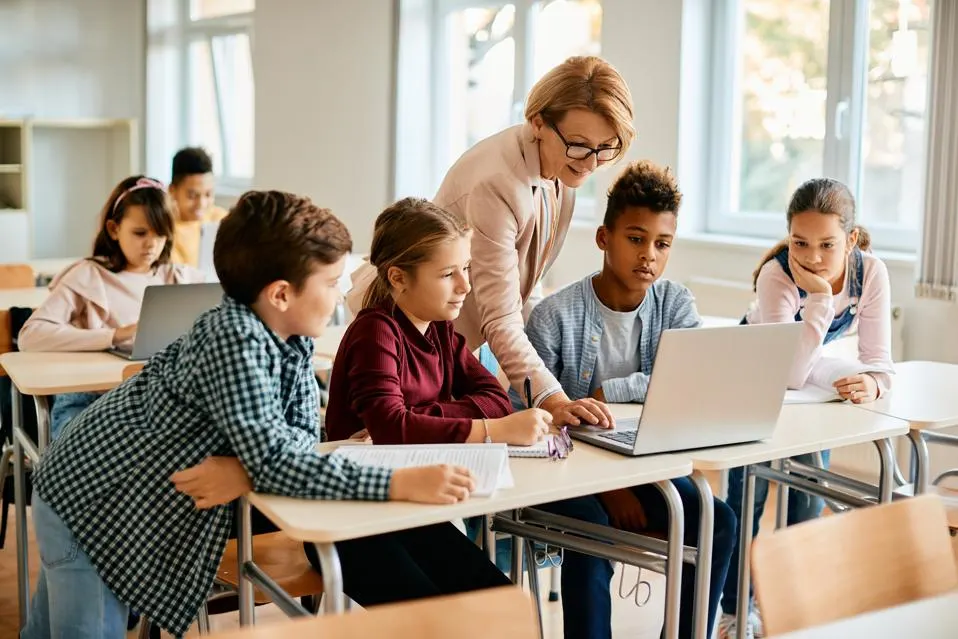
Technology has transformed this paradigm by introducing real time diagnostic telemetry into the instructional workflow. Modern learning management systems and adaptive software platforms provide teachers with a continuous stream of data regarding individual student performance.
This shift allows for the implementation of precision pedagogy. As students interact with digital modules, the backend software tracks metrics such as submission velocity, hesitation patterns on specific logic problems, and the exact moments when a learner reviews instructional videos. Teachers use these aggregated dashboards to perform immediate, targeted interventions. If the data shows that five students are struggling with a specific mathematical formula, the teacher can pull those individuals into a small group session for personalized remediation while the rest of the class advances through higher level applications. This data driven approach ensures that no student slips through the cracks due to a lack of instructional visibility.
Managing the Hybrid Learning Environment
The contemporary educator must possess a dual professional identity, operating comfortably in both physical classrooms and virtual learning environments. This hybrid reality requires a complete reconfiguration of lesson design and student engagement strategies.
In a hybrid model, teachers must carefully determine which educational activities are best suited for synchronous, face to face interactions and which can be offloaded to asynchronous digital platforms. This has led to the widespread adoption of the flipped classroom methodology. In this framework, teachers record their core lectures or curate instructional multimedia for students to consume independently at home. The physical classroom time is then liberated from passive listening and dedicated entirely to interactive workshops, laboratory experiments, peer collaboration, and immediate teacher troubleshooting.
Furthermore, managing a digital learning environment requires a high degree of technological agility. Teachers must master a diverse suite of collaborative software, digital whiteboards, and video communication platforms. They must establish clear behavioral guidelines for digital citizenship, ensuring that online discussions remain professional, inclusive, and free from the distractions that naturally accompany internet usage.
The Human Factor in an Automated Educational Landscape
As artificial intelligence and automated tutoring systems become increasingly sophisticated, questions naturally arise regarding the future necessity of human teachers. While algorithms excel at data processing, routine grading, and serving repetitive practice problems, they are entirely incapable of replicating the core human elements that drive deep, transformative learning.
Learning is an inherently social and emotional endeavor. The human brain is neurobiologically wired to learn through relationship, empathy, and social modeling. A human teacher provides the emotional scaffolding that allows students to navigate the intense vulnerability of failure and growth.
Cultivating Soft Skills and Emotional Resilience
-
Reading Non Verbal Cues: A human instructor can instantly sense the subtle shifts in classroom energy, identifying frustration, anxiety, or boredom through a student’s posture, eye contact, or tone of voice, adjusting the pressure of the lesson accordingly.
-
Modeling Ethical Leadership: Through daily personal interactions, teachers demonstrate the nuances of conflict resolution, cultural empathy, intellectual humility, and personal integrity.
-
Providing Authentic Motivation: An algorithm can offer digital badges and points, but it cannot provide the profound validation that comes from a respected mentor recognizing a student’s hard work and unique potential.
The ultimate goal of modern educational technology is not to replace the human element, but to liberate it. By automating administrative tasks, routine assessments, and basic data delivery, technology frees teachers to focus entirely on their true calling: building deep professional relationships that inspire curiosity, resilience, and a lifelong love of learning.
Frequently Asked Questions
How do modern teachers handle the issue of digital distraction when devices are integrated into lessons?
Managing digital distraction requires a shift from passive monitoring to active structural integration. Successful teachers do not simply give students free access to screens; they utilize applications that lock devices into specific, interactive tasks during the lesson. Furthermore, teachers structure lessons in brief, dynamic segments, alternating between ten minutes of active device usage, fifteen minutes of physical group discussion, and five minutes of independent reflection. This variable pacing prevents the cognitive fatigue that leads students to wander onto non-academic websites.
What strategies can educators use to ensure equity for students who lack reliable internet access at home?
Addressing the digital divide requires careful, inclusive lesson architecture. Teachers avoid designing mandatory homework assignments that require continuous, high-bandwidth internet connections. Instead, they utilize platforms that allow students to download course materials, video lectures, and readings onto their devices while on the school’s local network, enabling offline access at home. Additionally, schools often establish physical resource centers or partner with community libraries to provide safe study spaces with reliable connectivity for vulnerable populations.
How has the shift toward technology changed how teachers evaluate student plagiarism and academic integrity?
The proliferation of advanced text generators and online solution repositories has made traditional essay prompts and multiple-choice take-home tests vulnerable to academic dishonesty. Consequently, educators are shifting toward process-oriented assessments and authentic evaluations. Instead of grading only the final written product, teachers evaluate the entire creation pipeline, requiring students to submit initial outlines, document revisions, and video reflections explaining their logic. Oral examinations and live presentations are also increasingly utilized to verify a student’s actual mastery of the material.
What type of professional development is most effective for helping veteran teachers adapt to new technologies?
Traditional professional development models that rely on single, passive lecture seminars are highly ineffective for technical training. Veteran educators benefit most from ongoing, job-embedded coaching and peer mentorship networks. Effective programs pair technologically proficient educators with veteran instructors to collaborate on actual lesson plans in real time. Providing teachers with structured, low-stakes sandbox environments where they can test new software without the pressure of immediate administrative evaluations is also critical for fostering institutional confidence.
How does the integration of technology affect a teacher overall workload and administrative burden?
In the initial implementation phase, adopting new technology can temporarily increase a teacher’s workload due to the steep learning curve of setting up digital workflows and modifying traditional curricula. However, once the infrastructure is established, technology significantly reduces administrative burdens. Automated grading for objective assessments, digitized attendance tracking, and reusable lesson templates save hundreds of hours annually, allowing teachers to reallocate their energy toward lesson customization and direct student mentorship.
How do teachers balance the use of digital tools with the development of traditional skills like handwriting and physical reading?
Thriving educators treat technology as a complementary asset rather than a complete replacement for analog learning. They practice sensory balancing within the curriculum. For example, while data analysis might be performed on a computer, the initial brainstorming, mapping of concepts, and early drafts are often completed using physical journals and sketchpads. Cognitive science proves that handwriting engages distinct neural circuits that aid in memory retention, so balanced classrooms maintain a strict dedication to physical reading and writing alongside digital fluency.